TerBit
____Real-Time Carbon Footprint Reduction
Designed a habit-based sustainability mobile appbgrounded in behavioral research, focused on reducing friction and increasing repeat daily action.
Role
Company
Timeline
Team
Product
Senior UX Designer
Tergo
2020-2021
PM
2 UX Designers
2 Engineers
Consumer Mobile App Mobile
Habit Formation
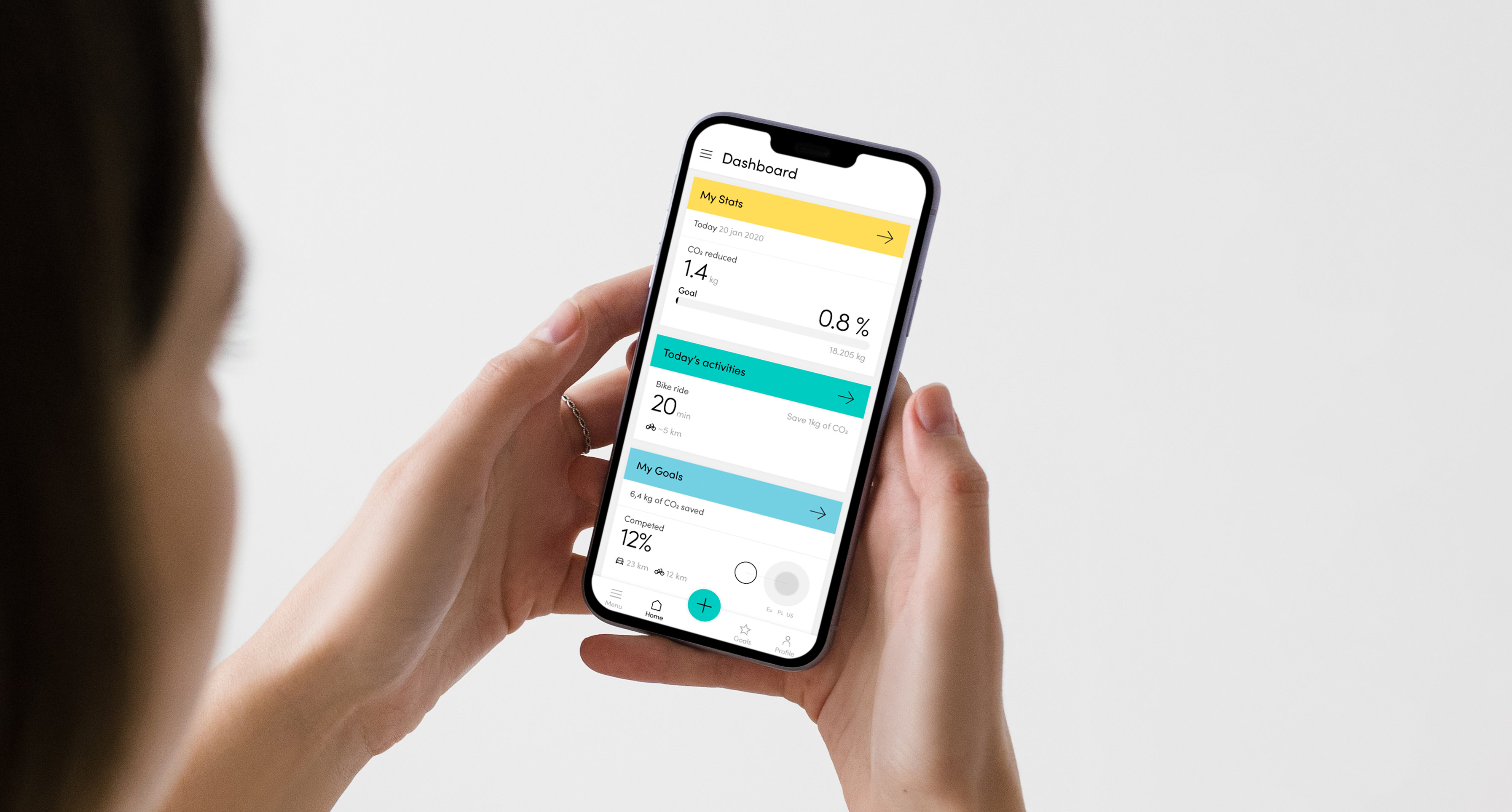
TerBit is a mobile application designed to supportcarbon footprint reduction through small, repeatable daily actions.The project focused on applying principles from habit formation andbehavioral science to help users move from environmental intent toconsistent, real-world behavior.
Rather than positioning sustainability as along-term commitment or abstract responsibility, TerBit treats it asa daily practice—supported by real-time feedback, low-frictioninteractions, and progress that accumulates over time. The goal wasto design a system that makes carbon reduction feel tangible,achievable, and worth repeating.
While awareness of climate change is high,sustained individual action remains limited.People who want to reduce their carbon footprintface several challenges:
1____Actions feel abstract, with delayed or unclear impact
2____Existing tools prioritize reporting overaction
3____Goal systems are often overwhelming orguilt-driven
4____High friction at the moment of action prevents consistency
5____Low transparency reduces trust in carbon offset solutions
As a result, motivation exists, but follow-through drops quickly after initial use.
Problem
Key Research Insights
Research across habit formation, digital health, and behavior-change interventions revealed consistent patterns relevant to this problem space:
1____Motivation alone does not sustain behavior
Habits form through repeated actions in stable contexts, not intent or awareness alone. [1]
2____Immediate feedback strengthens habit loops
Timely feedback reinforces the action–outcome connection and improves short-term re-engagement. [2, 3]
3____Early cognitive load increases abandonment
Too many early decisions reduce activation and short-term retention in habit and health apps. [7, 8, 9]
4____Concrete action plans outperform abstract goals
Clear “what to do next” guidance increases completion and repeat behavior. [5, 6]
5____Progress framing affects resilience
Cumulative progress supports persistence better than streak-only or binary success models. [1, 4]
6____Trust and social context influence engagement
Transparent impact communication and optional social reinforcement support continued use. [10, 11]
Design a mobile experience that:
1____Gets users to meaningful actionquickly
2____Makes carbon impact visible while actions are happening
3____Supports habit formation without pressure or guilt
4____Reduces friction during early use
5____Builds trust through transparent, understandable feedback
Success was defined not by one-time engagement,but by the likelihood that users would return and repeat actions overtime.
Goal
1____Reduce friction at every step
Minimize decisions, default where possible, and focus on one primary action ata time.
2____Deliver value immediately
Ensure users seeevidence that their actions matter within the first session.
3____Support habits, not streak anxiety
Designfor long-term consistency rather than perfect behavior.
4____Progress over performance
Emphasize cumulative impact and personal growth rather than comparison.
5____Transparency builds trust
Make impact calculations and progress easy to understand and verify.
Design Principles
Solution - Key Design Decisions
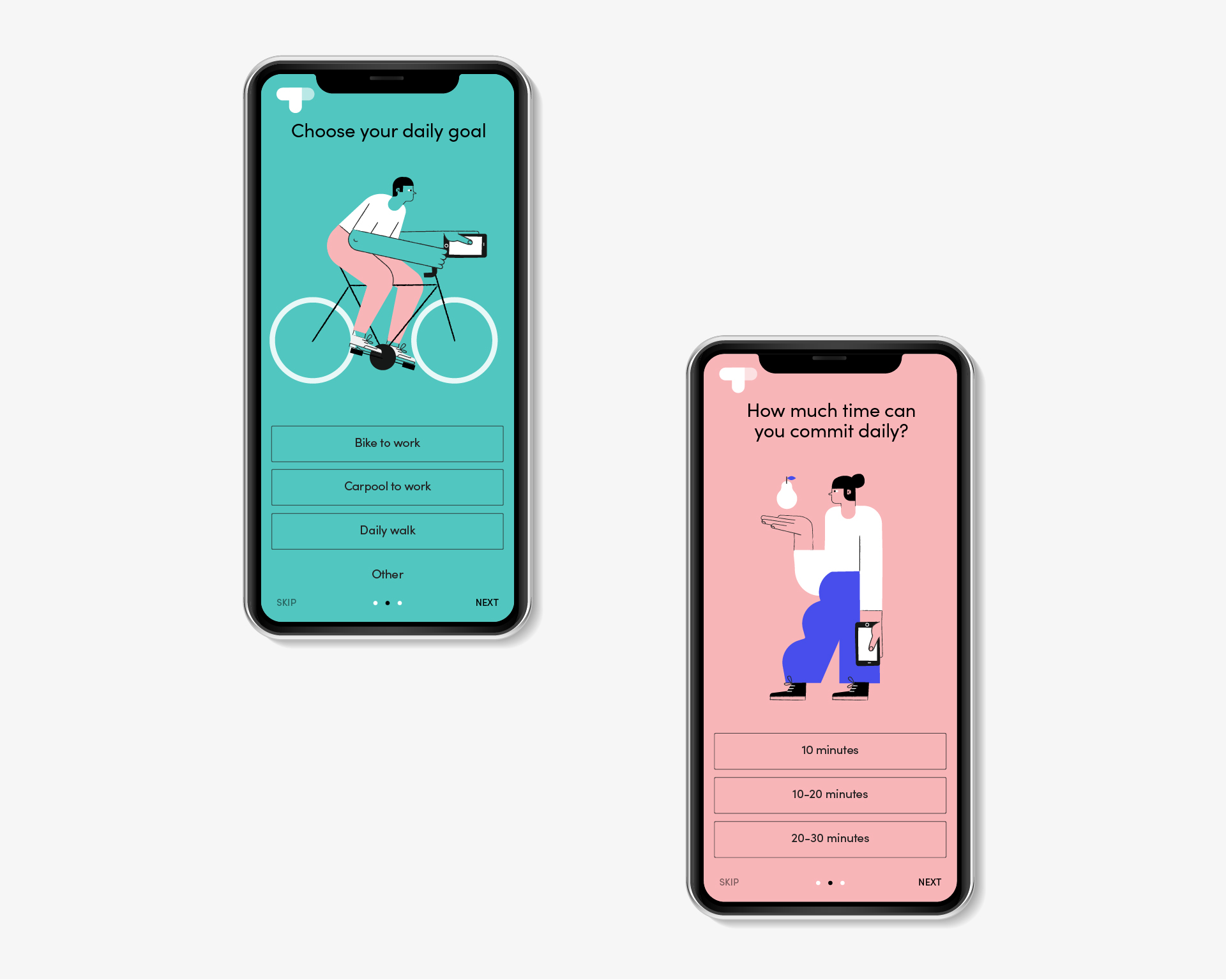
Onboarding____Guided Setup Without Commitment Pressure
Personalize the experience while minimizing early friction.
Onboarding flow:
1____Activity to start offsetting carbon from
2____Daily time commitment
3____Starter goal
Each step focuses on one decision, with a clear “Skip and try now” option.
Why
Personalization increases relevance, but early over-commitment increases drop-off. Progressive disclosure balances autonomy and ease, while the skip option allows users to experience value first.
Benchmarks
1____Short, step-based onboarding flows consistently achieve ~85–92% completion vs significantly lower rates for long, checklist-style onboarding.[7]
2____Reducing early cognitive load improves activation and short-term retention in habit and health apps. [1,8,9]
3____Allowing users to defer decisions (skip customization) reduces abandonment in first sessions. [6,7]
Dashboard____Action first
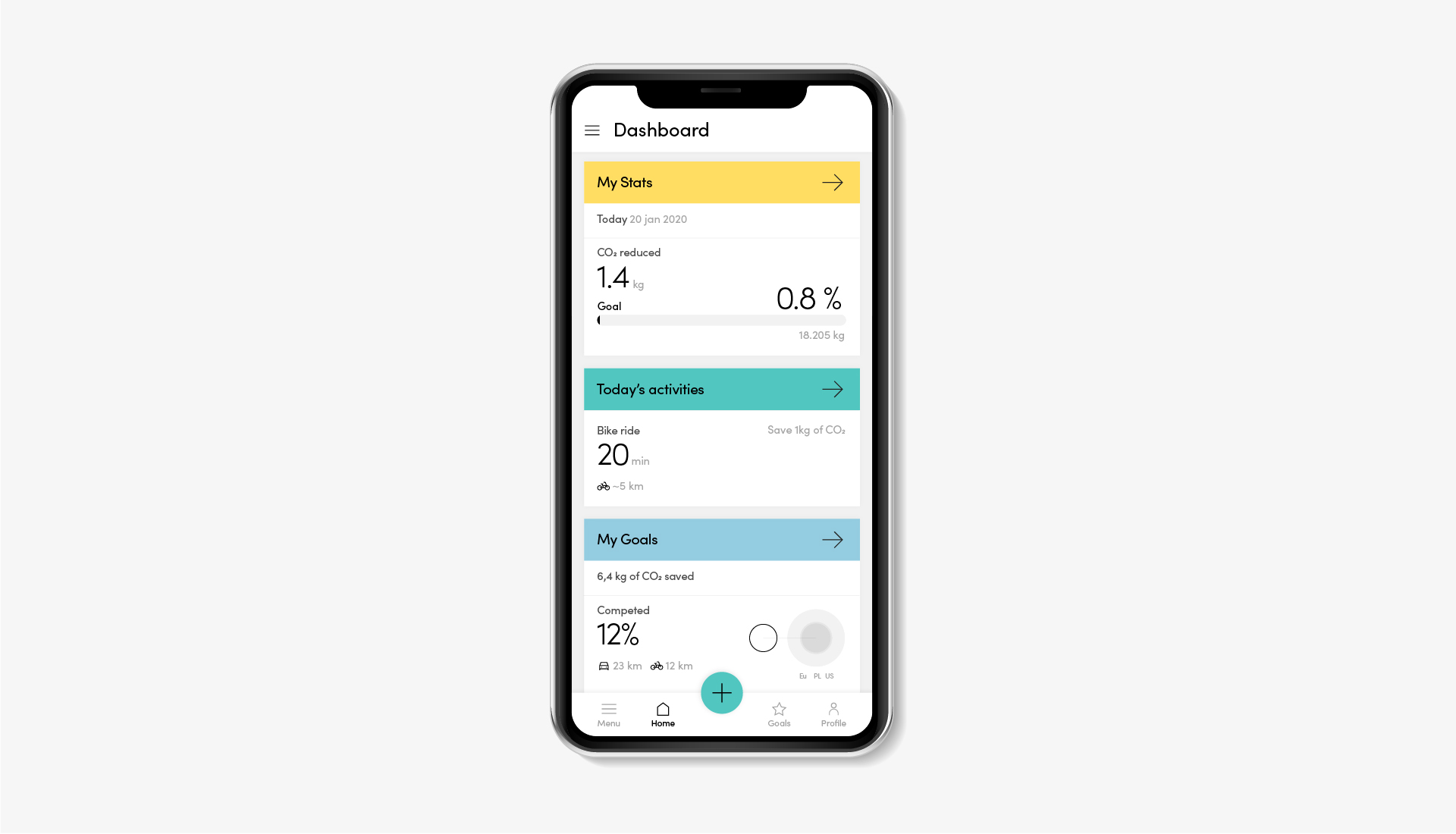
Make the dashboard the daily habit cue: feedback → action → direction. Keep long-term direction visible without overwhelming the user.
Layout(top to bottom):
1____Weekly stats (+ streak)
2____Your activities for today
3____Goals
Why
Sequence mirrors the habit loop: feedback → action → long-term motivation. Placing stats first provides an immediate reward, while the action list reduces friction at the moment of decision, goals secondary placement provide direction without overwhelming.
Benchmarks
1____Immediate, salient feedback is associated with ~10–25pp uplift in short-term return compared to delayed feedback. [2,3]
2____Implementation-intention–style task lists increase completion and repeat behavior. [5,6]
3____Habit and health apps combining feedback + clear primary actions reach upper-range Day-7 retention (~35–45%).[12]4____Contextual goal sections receive ~40–60% session interaction when placed after actionable content.[6]
Tracking____Single Focus, Real-Time Impact
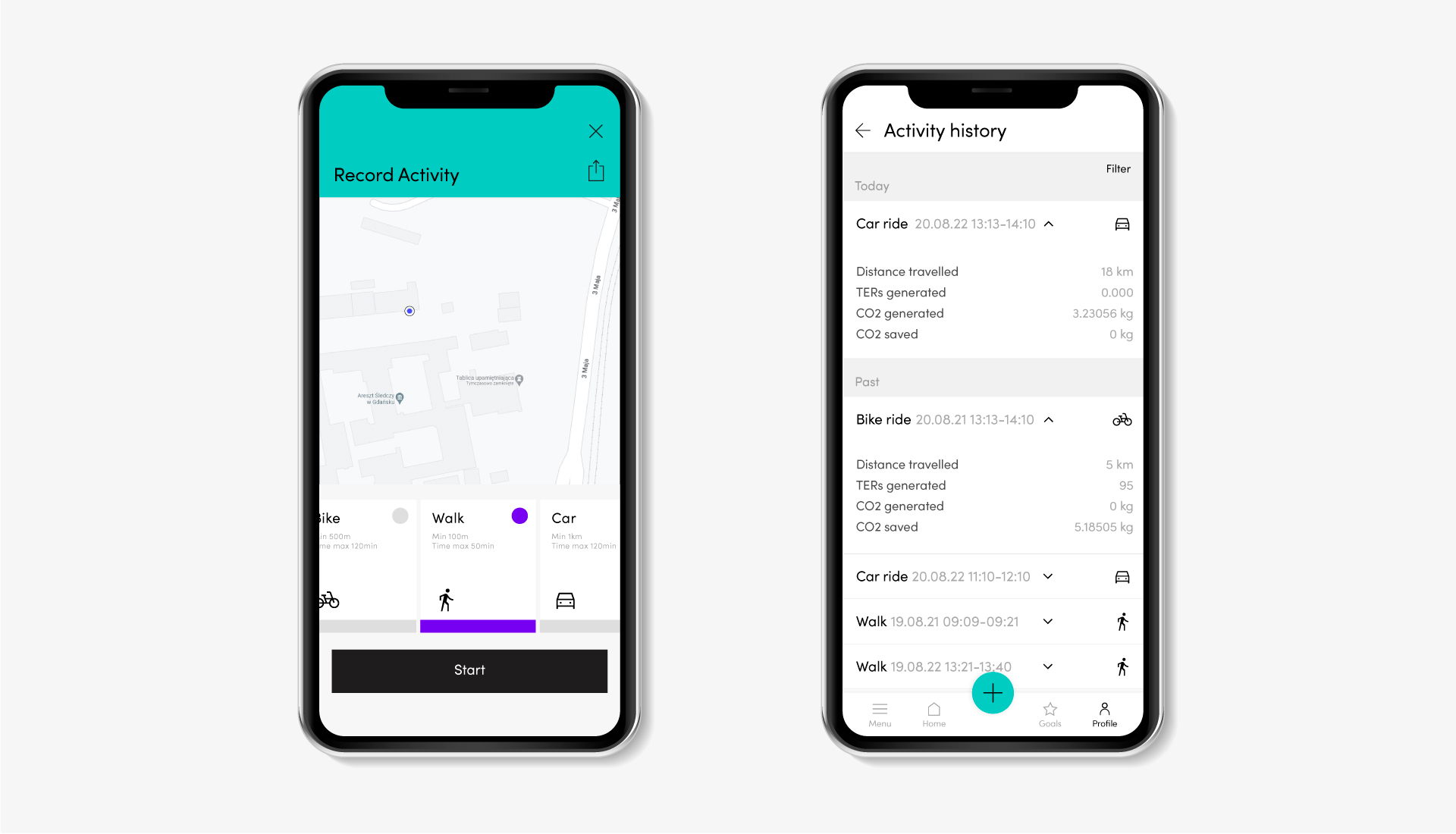
Reduce friction at the moment of action and reinforce impact while the action is happening.
1____Single-focus UI
2____Activity defaults to onboarding choice
3____Live CO2 offset feedback during activity
4____Prominent Start button - easily clickable target
Why
Reducing choice and visual clutter lowers decision friction. Live feedback turns abstract impact into a tangible, real-time experience.
Benchmarks
1____Single-CTA interfaces reduce time-to-action to ~5–12 seconds, compared to ~15–25 seconds for multi-option screens.[9]
2____Real-time feedback during behavior increases engagement and perceived impact compared to post-hoc summaries. [2,3]
3____Lower time-to-action correlates with higher session completion and repeat use in habit-forming apps.[1]
Goals____Progressive Unlocking
Support long-term change withoutoverwhelming users early.
1____One active goal fully visible
2____Locked,view-only upcoming goals
3____Current stats tied to the active goal
Why
Progressive disclosure reduces cognitiveload and encourages curiosity. Completing one goal builds confidencebefore introducing the next.
Benchmarks
1____Progressive goal systems show ~15–40% highercontinued engagement compared to static goal lists, depending ondomain and cohort. [4]
2____Presenting too many goals at once reducesfollow-through and increases abandonment. [4, 1]
Immediate Feedback____Reinforcing Competence
Close the feedback loop immediately after action.
1____Post-activity overlay
2____Clear CO2 offset numbers
3____Contextual equivalents
4____Reflection of live tracking data
Why
Immediate feedback strengthens the association between action and outcome, reinforcing competence and encouraging repetition.
Benchmarks
1____Immediate feedback interventions produce ~10–25pp higher short-term return rates than delayed feedback.[2,3]
2____Feedback combined with self-monitoring is among the most effective behavior change technique combinations.[3,4]
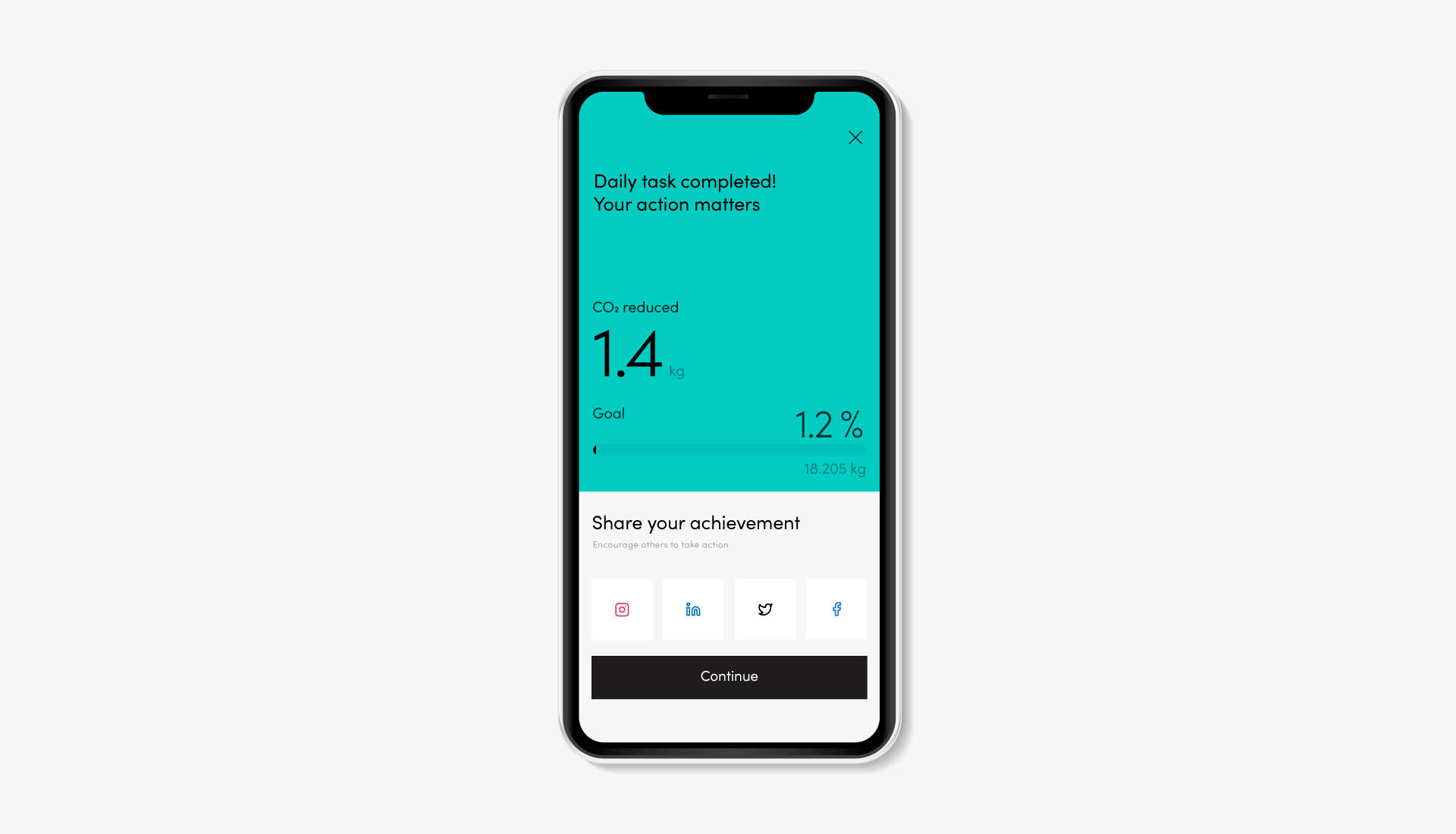
Social Sharing____Low Friction, Optional Reward
Enable celebration and social proof without pressure.
1____Pre-designed share cards after activity completion
2____Platform selection (Instagram, etc.)
3____No additional configuration required
Why
Reducing friction increases sharing likelihood; making sharing optional preserves intrinsic motivation.
Benchmarks
1____Optimized, low-friction sharing produces ~20–60 shares per 1,000 active users in lifestyle and habit apps.[11]
2____Social proof and identity reinforcement support continued engagement and motivation.[10]
Progress Visualization____Beyond Streaks
Encourage persistence without punishing lapses.
1____Dashboard progress card with encouragement and streak comparison
2____“Your progress” screen showing CO2 offset by day, week, month, year, all time
3____Activity summary cards: total time, completed activities, record streak
Why
Streak-only systems can demotivate after a single break. Cumulative progress supports resilience and long-term adherence.
Benchmarks
1____Cumulative progress framing improves persistence compared to binary success/failure feedback. [1,4]
2____Self-monitoring over longer time horizons (weekly/monthly summaries) supports sustained behavior change.[3]
Outcomes & Learnings
1____Clearer conversion from intention to action
Real-time feedback, explicit daily actions, and progressive goals work together to reduce the gap between motivation and follow-through—an essential requirement for habit-forming products.
2____Reduced early-use friction
Simplified onboarding, default selections, and single-focus interactions lower cognitive load during early sessions, supporting activation and short-term retention.
3____Progress framing that supports resilience
Emphasizing cumulative impact and personal records, rather than streak-only success, helps maintain engagement even when users miss days.
4____Systems over individual features
The strongest results came from designing an integrated system of feedback, action cues, and progress—rather than optimizing isolated features.
5____Early moments matter disproportionately
Decisions made in onboarding and first-use experiences have an outsized impact on long-term engagement and should be treated as core product work.
References
1____Lally, P., Van Jaarsveld, C. H. M., Potts, H. W. W., & Wardle, J. — How Are Habits Formed: Modelling Habit Formation in the Real World, 2010
2____Larson, E. L., et al. — Feedback as a Strategy to Change Behavior: The Devil Is in the Details, 2011
3____Michie, S., Abraham, C., Whittington, C., McAteer, J., & Gupta, S. — Effective Techniques in Healthy Eating and Physical Activity Interventions: A Meta-Regression, 2009
4____Michie, S., Richardson, M., Johnston, M., et al. — The Behavior Change Technique Taxonomy (v1) of 93 Hierarchically Clustered Techniques, 2013
5____Gollwitzer, P. M. — Implementation Intentions: Strong Effects of Simple Plans, 1999
6____Dennison, L., Morrison, L., Conway, G., & Yardley, L. — Opportunities for Smartphone Applications in Supporting Health Behavior Change, 2013
7____Stål, J. — Designing for Progressive Disclosure in Interactive Onboarding, 2020
8____Nielsen Norman Group — Time-to-Value and User Onboarding, 2018
9____Mejtoft, T. — Cognitive Load and Interaction Friction in User Interface Design, 2019
10____Cialdini, R. B. — Influence: Science and Practice, 2009
11____Branch — Mobile Sharing and Referral Benchmarks, 2020
12____Adjust — Mobile App Retention Benchmarks, 2021